
Lukan Priority
Progressive Embellishment, Luke→Mark→Matthew
In this study, we examine 36 Synoptic cases of two-stage progressive embellishment from Luke → Mark → Matthew—passages in which Mark expands or dramatizes Luke, and Matthew in turn polishes, expands, or heightens Mark while drawing directly on both predecessors. Together with 28 additional two-Gospel parallels exhibiting expansion from Luke to Mark, the material analyzed here accounts for approximately 65% of the Gospel of Mark and 25% of the Gospel of Matthew. The cumulative literary and quantitative evidence supports Lukan priority (Luke composed first among the Synoptics) and Matthean posteriority (Matthew composed last among the Synoptics), challenging Markan priority under both the Two-Source Hypothesis and the Farrer Hypothesis.
Methodology
In this article, we examine thirty-six triple-tradition Synoptic parallels exhibiting two stages of progressive embellishment (Luke → Mark → Matthew), followed by a summary tabulation of twenty-eight additional two-Gospel parallels exhibiting editorial expansion from Luke to Mark. The methodology of the analysis is as follows:
- Identify parallels among the three Synoptic Gospels in which two stages of progressive embellishment can be traced from Luke to Mark and from Mark to Matthew:
- Parallels were collated in Accordance Bible Software against three standard gospel synopses and harmonies: (1) Kurt Aland, ed., Synopsis Quattuor Evangeliorum, 13th rev. ed. (Stuttgart: Deutsche Bibelgesellschaft, 1985; 15th rev. ed., 1996); (2) A. T. Robertson, A Harmony of the Gospels for Students of the Life of Christ (New York: Harper & Brothers, 1922); and (3) Albert Huck and Hans Lietzmann, Synopsis of the First Three Gospels, 9th ed., English ed. by F. L. Cross (Oxford: Basil Blackwell, 1936).
- Pericope boundaries follow primarily Kurt Aland’s Synopsis Quattuor Evangeliorum (13th rev. ed., 1985), supplemented where Matthew distributes parallel sayings across two discourse contexts.
- Calculate the Greek word count for each parallel passage from the standard critical Greek text, Novum Testamentum Graece, 28th rev. ed., ed. Barbara Aland, Kurt Aland, Johannes Karavidopoulos, Carlo M. Martini, and Bruce M. Metzger (Stuttgart: Deutsche Bibelgesellschaft, 2012 [NA28]).
- Display the parallel texts side by side in the Revised Standard Version (RSV; New Testament first published 1946; 2nd ed., 1971), arranged from Luke to Mark to Matthew.
- Mark shared wording neutrally across the three columns (bold for wording shared with Luke, underline for wording shared with Mark, italic for wording shared with Matthew), treating routine inflected variations in number, tense, or mood as matches unless the grammatical shift carries substantive narrative significance.
- Identify specific editorial differences across the parallel accounts, including expansions, dramatizations, conflations, and narrative inconsistencies.
- Classify the literary character of each significant change observed, including:
- Addition of heightened or sensational narrative details
- Escalation in rhetorical or ethical severity
- Shift from concise narration to expanded dialogue and dramatic staging
- Insertion of explanatory glosses resolving ambiguities in the more primitive text
- Conflation of multiple source phrases into a more polished composite text
- Redactional reshaping driven by literary, liturgical, or theological aims
- Analyze narrative and doctrinal inconsistencies introduced across the Synoptic sequence (Luke → Mark → Matthew) and evaluate the direction of literary dependence that best explains them.
- Compare the relative length and editorial profile of each parallel across Luke, Mark, and Matthew.
- Tabulate the aggregate Greek word counts across all cases examined to assess the macro-level pattern.
- Synthesize the literary and statistical conclusions regarding Synoptic order.
Parallels Examined
Thirty-six Synoptic parallels exhibiting two stages of progressive embellishment were identified and examined:
- Plucking Grain On the Sabbath, Luke 6:1-5 → Mark 2:23-28 → Matt 12:1-8
- Gathering of the Multitude, Luke 6:17-19 → Mark 3:7-10 → Matt 4:23-5:1
- Reason for Parables, Luke 8:9-10→ Mark 4:10-12→ Matt 13:10-17
- My Mother and Brothers, Luke 8:21→ Mark 3:34-35→ Matt 12:49-50
- Instructions of What Not to Carry, Luke 9:3→ Mark 6:8-9→ Matt 10:9-10
- Jesus Foretells His Death, Luke 9:22-27→ Mark 8:31-9:1→ Matt 16:21-28
- Transfiguration, Luke 9:29-36→ Mark 9:2-13→ Matt 17:1-13
- Receiving a Child, Luke 9:46-48 → Mark 9:33-37 → Matt 18:1-5 + Matt 10:40-42
- Casting Out Demons in Your Name, Luke 9:49-50→ Mark 9:38-40 → Matt 7:21-23 + Matt 12:30
- Asking For a Sign, Luke 11:16 → Mark 8:11-12 → Matt 16:1-4
- Beware of the Leaven, Luke 12:1→ Mark 8:15-21 → Matt 16:6-12
- Blasphemy Against the Holy Spirit, Luke 12:10 → Mark 3:28-29 → Matt 12:31-32
- Request To Sit at Jesus’ Right Hand, Luke 12:50 + Luke 22:24-27 → Mark 10:35-45 → Matt 20:20-28
- Withering of the Fig Tree, Luke 13:6-7 → Mark 11:12-14, 20-21 → Matt 21:18-20
- Saltiness, Luke 14:34-35 → Mark 9:49-50 → Matt 5:13
- Teaching on Divorce and Adultery, Luke 16:18→ Mark 10:2-12→ Matt 19:3-12 + Matt 5:27-28, 31-32
- It Would Be Better Sayings, Luke 17:1-2→ Mark 9:42-48 → Matt 18:6-10 + Matt 5:29-30
- Faith, Luke 17:5-6 → Mark 11:22-23 → Matt 17:20 + Matt 21:21-22
- False Christs, Luke 17:23-24 → Mark 13:21-23 → Matt 24:23-27
- Rich Ruler, Luke 18:18-24 → Mark 10:17-23 → Matt 19:16-23
- Healing of a Blind Man, Luke 18:35-43→ Mark 10:46-52→ Matt 20:29-34 + Matt 9:27-31
- Cleansing of the Temple, Luke 19:45-48→ Mark 11:15-19→ Matt 21:12-17
- Dared to Ask Him Any Questions, Luke 20:40→ Mark 12:34→ Matt 22:46
- Question About the Son of David, Luke 20:41-44→ Mark 12:35-37→ Matt 22:41-46
- Delivering Up To the Synagogues, Luke 21:10-19 + 12:11-12→ Mark 13:8-13 → Matt 24:7-14 + Matt 10:16-22
- End Times, Luke 21:20-28 → Mark 13:14-20, 24-27 → Matt 24:15-22, 28-31
- Unknown Day and Hour, Luke 21:29-36→ Mark 13:28-37→ Matt 24:32-51 + Matt 25:1-13
- Priests Plot to Kill Jesus, Luke 22:1-2→ Mark 14:1-2→ Matt 26:1-5
- Jesus Predicts His Betrayal, Luke 22:21-23→ Mark 14:18-21→ Matt 26:21-25
- Peter’s Denial Predicted, Luke 22:31-34 → Mark 14:26-31 → Matt 26:30-35
- Jesus’ Prayer, Luke 22:41-42 → Mark 14:35-36 → Matt 26:39
- Betrayal With a Kiss, Luke 22:47-53 → Mark 14:43-52 → Matt 26:47-56
- Jesus Before the Council, Luke 22:66-71 → Mark 14:53-65 → Matt 26:57-68
- Questioning by Pilate, Luke 23:3-4→ Mark 15:2-5→ Matt 27:11-14
- Jesus Sentenced to Death, Luke 23:16-25 → Mark 15:6-15 → Matt 27:15-26
- Burial of Jesus, Luke 23:50-55→ Mark 15:42-47→ Matt 27:57-66
1. Plucking Grain on the Sabbath
- Luke 6:1-5, is the shortest text, almost completely adopted by Mark and Matthew.
- All the Lukan words attributed to Jesus are used in Mark and Matthew
- Mark 2:23-28, adds more expository text and references.
- Most significantly, Mark 2:27 adds “the Sabbath was made for man, not man for the Sabbath”
- A couple of Markan stereotypes are exhibited in Markan revisions including 'began', 'look', and 'even.' For More on Markan stereotypes, see the article, List of Markan Stereotypes and Pick-ups
- Matthew 12:1-8 is significantly more expansive than Mark
- Three verses, Matt 12:5-7, are unique to Matthew, providing further justification for breaking the Sabbath
- Matthew gives a different statement preceding “the Son of man is Lord of the Sabbath” than Mark does, resulting in an inconsistency with Mark
- The evidence Matthew derives from Mark is indicated by what is underlined, including 'began', 'look', and “He said to them.”
- The evidence indicates that a progression from Luke to Mark to Matthew (editorial expansion) is much more plausible than the redaction of Luke in view of Mark or Matthew.
2. Gathering of the Multitude
Each of the three Synoptic Gospels includes a major summary scene in which Jesus ministers to a great multitude. Mark and Matthew exhibit progressive expansion of this setting in its topography, narrative staging, scope of healings, and the geographic radius from which the crowds gather.
- Luke 6:17-19, the more primitive tradition indicates that the scene of Jesus preaching to “a great multitude” is a level place (Plain)
- This plain is not a very prestigious place for Jesus to meet the multitude and give the major sermon of Luke, what is to follow, the Sermon on the Plain (Luke 6:20-49)
- Luke indicates Jesus was in the crowd as they sought “to touch him” (Luke 6:19)
- What follows is the “Sermon on the Plain” (Luke 6:20-49)
- Mark 3:7-12, is more expressive than Luke in describing the magnitude of people and related precautions.
- Mark relocates Jesus to preaching on a boat while the crowd listens on land.
- Jesus, having a boat ready for him (Mark 3:9), places him in a more esteemed place (a distinguished position apart from the crowd)
- This prevents the crowd from pressing in on Jesus and crushing him, as one might anticipate in the context of Luke.
- The rationale for this is Mark 3:10, “for he had healed many so that all who had diseases pressed upon him to touch him.
- The passage in Mark is not accompanied by a sermon. This is not surprising since the author focused more on the actions and story of Jesus rather than sermons and long parables.
- Mark relocates Jesus to preaching on a boat while the crowd listens on land.
- Matthew 4:23-5:1
- Matthew places Jesus in an even more prestigious place; a Mountain. What follows in his preaching from the mountain, “the Sermon on the Mount” of Matthew chapters 5-7.
- The preaching to follow in Matthew comprises 111 verses (3 complete chapters), in contrast to the “Sermon on the Plain” of Luke 6:20-49 with 29 verses (half a chapter). The Matthean discourse is nearly four times as long and is widely recognized in Synoptic scholarship as a composite literary expansion incorporating shorter core discourse preserved in Luke’s Sermon on the Plain (see, e.g., Hans Dieter Betz, The Sermon on the Mount, Hermeneia [Minneapolis: Fortress Press, 1995], pp. 44–88; Evan Powell, The Myth of the Lost Gospel [Las Vegas: Symposium Press, 2006], pp. 42–43). For further analysis, see The Sermon on the Mount: The Matthean Jesus Is Not the Historical Jesus.
- The preaching from the Mountain, as framed in Matthew, parallels Moses on the Mountain as a mediator of God and lawgiver.
- Matthew states, in an unequivocal manner, that Jesus was “healing every disease and every infirmity among the people. In Luke, the healing is more contextualized with respect to the crowd who sought to touch him. And Mark uses the term 'many', rather than 'all'.
- Matthew places Jesus in an even more prestigious place; a Mountain. What follows in his preaching from the mountain, “the Sermon on the Mount” of Matthew chapters 5-7.
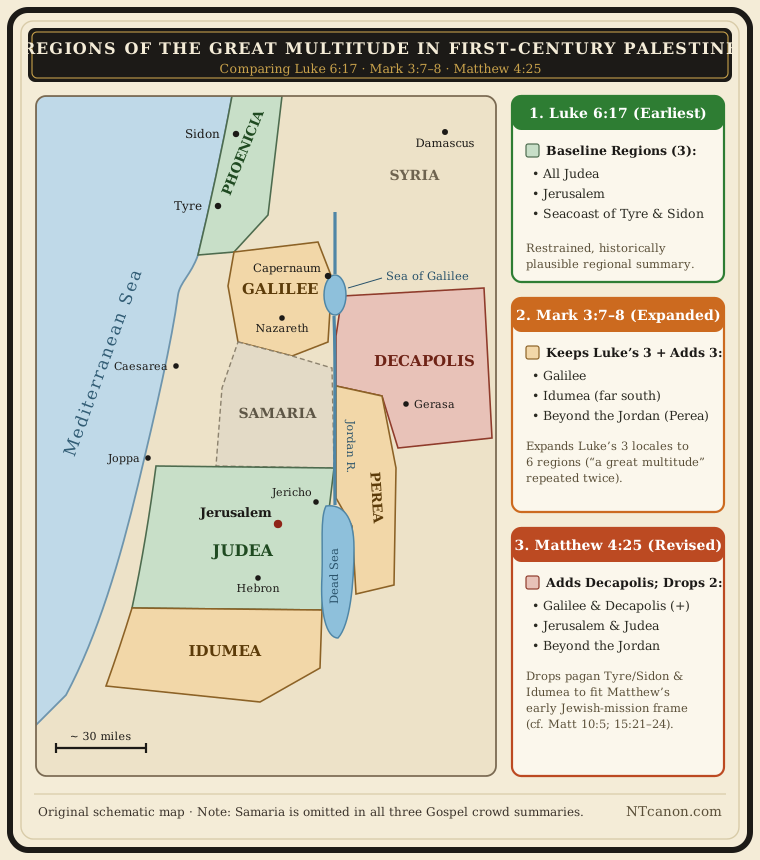
A Comparison of the Regions Mentioned
- Luke 6:17 indicates those who came were from the Regions including Judea and Jerusalem and the seacoast of Tyre and Sidon, which is a moderate distance from Galilee.
- Mark 3:7-8 adds “from Galilee followed” and increases the list of regions from which people came to include Idumea and from beyond the Jordan. These are more distant regions from those mentioned in Luke 6:17.
- Matt 4:24–25 expands the geographic horizon still further, adding “all Syria” (v. 24) and the Decapolis (v. 25), the league of Hellenistic cities east and southeast of the Sea of Galilee.
- Looking at the map, we see that the regions mentioned become more distant in Mark and Matthew than those in Luke. This is a type of embellishment indicating people were coming from farther and farther distances as the Gospels were rewritten and expanded.
3. Reason for Parables
- Luke 8:9-10 is the shortest text, with core elements adopted in Mark and Matthew
- Mark 4:10-12 adds more expository text and references
- Mark pulls in some additional wording from Isaiah, including 'perceive' and 'turn'.
- Matthew 13:10-17 is largely expanded to about three times the length of Mark
- Matthew is a hybrid text, with some elements particular to Luke and some elements particular to Mark
- Matthew more directly and extensively quotes Isaiah
- Matthew shares some wording with Mark as indicated by the underlined text including notable words 'perceive', 'indeed', and 'turn'.
4. My Mother and Brothers
- Luke 8:21 is the shortest quote of Jesus on a pivotal statement
- Mark 3:34-35 expands on the text and dramatizes it.
- Rather than just making a theoretical statement, Mark reframes the statement to be applied to those directly around them. Jesus looks around at those who sat about him and says directly, “here are my mother and my brothers!”
- Mark improves the quote by making it directly to “whoever does the will of God” rather than the less direct “those who hear the word of God and do it.”
- Mark adds 'sister' in addition to Mother and brothers.
- Matthew 12:49-50 is a further enhancement
- Instead of “looking around and saying” in Mark 3:34, the parallel in Matthew, describes Jesus as stretching out his hand toward his disciples, an even more dramatic gesture.
- “God” is changed to “my Father in heaven,” a further embellishment.
5. Instructions of what not to carry
- Luke 9:3 is the short and concise text of a list comprising only prohibited items
- Luke mentions silver money
- Mark 6:8-9 expands on the base text and provides an improved edit
- Mark changes silver money of Luke to copper money. This is a more extreme prohibition since it implies no money (not even of the least value copper coins)
- Mark changes the staff of Luke to “except a staff” resulting in a contradiction.
- Now the list is not exclusively prohibited items but includes two permitted items (a staff and sandals)
- Mark adds “no bread” to the list of prohibited items.
- Mark changes silver money of Luke to copper money. This is a more extreme prohibition since it implies no money (not even of the least value copper coins)
- Matthew 10:9-10 is clearly a hybrid of Luke and Mark
- The editor incorporated the silver of Luke, and the copper of Mark, and added gold as well.
- These same words used for silver and copper in Matthew are simply rendered as 'money' in Luke and Mark.
- Because silver and copper are used together, a distinction must be made between the two in Matthew.
- Matthew changes the allowance of sandals in Mark to a prohibition
- Both sandals and a staff are prohibited in Matthew, whereas they are allowed in Mark.
- This constitutes a double contradiction between Mark and Matthew.
- Matthew makes Jesus' list of prohibited items the most extreme of the three gospels. The general tendency of the progression of the gospel tradition is toward increasing severity from Luke to Mark to Matthew.
- The added phrase “for the laborer deserves his food” is a response to the “no bread” of Mark
- Thus, Matthew is reversing the prohibition of bread in Mark – another inconsistency.
- This is a great example of the author of Matthew seeing both Luke and Mark before him and blending the two traditions together with further editing and embellishment.
- The editor incorporated the silver of Luke, and the copper of Mark, and added gold as well.
6. Jesus Foretells his Death
- Luke 9:22-27 is the shortest text in which almost every word of the text is used in Mark and Matthew
- Mark 8:31-9:1 adds much to the text, which is mostly adopted by Matthew
- A notable addition is Peter's rebuke of Jesus in Mark 8:32-33
- Mark 8:36 changes “himself” of Luke 9:25 to “his life,” often translated as “his soul” in translations. This change by itself is a notable improvement that is a more familiar way of quoting the saying for most believers.
- Mark 8:37 adds, “For what can a man give in return for his life?” A profound saying that Matthew adopted and that Luke would not have omitted if it were part of the early tradition.
- Mark 8:38 adds, “in this adulterous and sinful generation”
- Matthew 16:21-28 edits out some excessive expansion of Mark and provides some improvements to the wording in a few places.
- The Matthean text relies heavily on Markan edits, as indicated by the underlined text.
- Matthew attempts to rehabilitate Peter by adding the words to Peter, “God forbid, Lord! This shall never happen to you” (Matt 16:22) Matthew is aimed at giving Peter the most favorable treatment of all four gospels.
- Matthew 16:23 adds the explanatory clause “You are a hindrance [skandalon] to me” to Jesus’ rebuke of Peter.
- The editor of Matthew removed the reference to not being ashamed of Luke and Mark, and the “adulterous and sinful generation” of Mark, and replaced these with a reference to good works in Matt 16:27, “and then he will repay every man for what he has done” (Matt 16:27) This corresponds to the Judaizing aims of the editor.
- The editor of Matthew further developed the last statement of Matt 16:28 to make a reference to Daniel, “before they see the Son of man coming in his kingdom” which is clearly an editorial development.
- Matthew is slightly shorter than Mark here on account of it being more polished and well edited
7. Transfiguration
- Luke 9:29-36 is the shortest text
- Luke doesn't exhibit the enhanced features of Mark and Matthew
- According to Luke 9:35, the voice says, “This is my Son, my Chosen; listen to him!”
- Mark 9:2-13 greatly expands the text.
- According to Mark 9:7, the voice says, “this is my beloved Son; listen to him.”
- Mark 9:9-10 adds some references to the Resurrection with respect to Jesus' command to tell no one what they had seen.
- Mark 9:9-10 adds, “until the Son of man should have risen from the dead. So they kept the matter to themselves, questioning what the rising of the dead meant.”
- Here we see a problematic addition that Matthew partially redacted.
- Matthew 17:1-13 is even more expansive than Mark
- Markan edits are mostly adopted by Matthew
- According to Matt 17:5, the voice says, “this is my beloved Son, with whom I am well pleased; listen to him.”
- This is a further expansion of Matthew to correspond with the baptism saying of Matthew 3:17.
- According to Matt 17:5, the voice says, “this is my beloved Son, with whom I am well pleased; listen to him.”
- Matthew adds, “his face shone like the sun.”
- While Luke and Mark describe Jesus' garments, Matthew adds a comment about his face, which is a detail the earlier traditions would not have omitted if it was part of it.
- Matthew 17:2 improves the description of the garments of Mark 9:3, “and his garments became intensely white, as no fuller on earth could bleach them” to “his garments became as white as light.”
- Matthew 17:6–8 expands the concise “Jesus was found alone” of Luke 9:36, and the narration of “and suddenly looking around they no longer saw anyone with them” of Mark 9:8 to a more dramatic account of “When the disciples heard this, they fell on their faces, and were filled with awe. But Jesus came and touched them, saying, “rise and have no fear. “ And when they lifted their eyes they found no one but Jesus alone.”
- Here, the author of Matthew clearly develops narration around the core elements of the primitive story to further dramatize it.
- In Mark, the references to Elijah are unclear. Matthew 17:13 clarifies this as an added verse, stating, “Then the disciples understood that he was speaking to them of John the Baptist.”
- We have observed that, in no less than a few places, Matthew has revised and expounded upon Mark.
- Markan edits are mostly adopted by Matthew
8. Receiving a Child
- Luke 9:46-48 is the shortest primitive text
- Luke contains the common core elements of parallels in Mark and Matthew, including a discussion of who was “the greatest,” a reference to a child, and the statement similar to Luke 9:48 “Whoever receives this child in my name receives me, and whoever receives me receives him who sent me.
- Mark 9:33-37 turns the narration into more of a complete scene filled with increased dialogue and drama.
- Mark 9:35 rewrites the more primitive statement of Luke 9:48 “he who is least among you all is the one who is great” to the polished statement, “If any one would be first, he must be last of all and servant of all.”
- The added detail of Jesus taking the child into his arms is an enhancement.
- Mark embellishes the core statement by making the application more explicitly universal using the terminology “one such” and by adding the “not me but”
- Matt 18:1-5 + Matt 10:40-42 exhibits the original single context being applied partially into two separate contexts, a practice that is common in Matthew.
- Matthew further polishes and sanitizes the questioning of the disciples and transforms the dispute/argument into a discussion pertaining to the kingdom of heaven.
- Matthew 18:3 is the addition more expressive and emphatic statement, “Truly, I say to you, unless you turn and become like children, you will never enter the kingdom of heaven.”
- Matthew 10:41-42 is added to further expand on the shared concept of Matt 10:40 "He who receives you receives me, and he who receives me receives him who sent me.
9. Casting out Demons in Your Name
- Luke 9:49-50 is the shortest primitive text
- Most of Luke is adopted by Mark
- Mark 9:38-40 adds more expository text and references
- Mark changes 'Master' of Luke to 'Teacher'
- Mark adds, “For no one who does a mighty work in my name will be able soon afterward to speak evil of me.” This is added for additional justification/clarification.
- Mark 9:40 changes 'you' to 'us' – “the one who is not against us is for us” – an improvement that gives the saying more universal applicability.
- Matthew 7:21-23 and Matt 12:30 are radically different responses to the passages in Luke and Mark
- Based on the changes, it is clear that the author of Matthew felt the sayings in Luke and Mark were objectionable. The editor(s) of Matthew comes from an anti-charismatic disposition, and thus the reverse is indicated in Matthew than the openness and permissibility in Luke and Mark.
- Matthew 7:21-23 is added at the end of the Sermon of the Mount to indicate that the ministry of prophecy, deliverance, and supernatural manifestations provides no correlation of being with Jesus. The implication will be that many who operate in spiritual gifts will be rejected as not being known by Christ and being 'lawless'. This corresponds to the ultra-conservative Judaizing / legalistic character of Matthew.
- Matt 12:30 invents the saying, “whoever is not with me is against me” rather than the “one who is not against us is for us” of Mark 9:40. Thus, the saying is modified in Matthew to give the opposite implication of Luke and Mark.
10. Asking for a Sign
- Luke 11:16
- Luke provides a single verse indicating that his opponents attempted to test Jesus and sought a sign from heaven
- Mark 8:11-12 expands on this by providing more detail and dramatization
- Mark adds additional details that it was the Pharisees that came and argued with Jesus
- Mark adds a dramatic reaction of Jesus that “he sighed deeply in his spirit”
- Mark adds a response from Jesus, “Why does this generation seek a sign? Truly, I say to you, no sign shall be given to this generation.” Thus, a single point of narration is turned into a dramatic scene comprising a semi-dialogue.
- Matthew 16:1-4, expands much on the words of Jesus in further embellishing Mark.
- Matthew adds ‘Sadducees’ with Pharisees.
- Matthew 16:2-4 is added, except for “no sign shall be given” of Mark 8:12
- Matthew turns the short and concise response of Jesus in Mark into a long-winded rebuke to his opponents.
11. Beware of the Leaven
- Luke 12:1 is the shortest primitive text
- The concise statement “Beware of the leaven of the Pharisees, which is hypocrisy” occurs in the context of a great crowd.
- Mark 8:15-21 adapts these core elements of Luke to create a theme of misunderstanding in which Jesus gives a warning and the disciples misunderstand.
- Mark added “the leaven of Herod” as Herod is portrayed as a major villain in Mark.
- According to the narrative in Mark, the disciples think Jesus is talking about bread and are confused. This provides an opportunity for Jesus to correct them for not yet perceiving and understanding.
- Mark turns the simple warning into an opportunity to reaffirm the miracles of the feeding of five thousand and the feeding of four thousand, in the context of questioning his disciples.
- Matthew 16:6-12 is not much more expansive than Mark but makes some notable changes.
- Matthew replaces the leaven of Herod of Mark with the Sadducees.
- The implication which seems to be missing in Mark, of the disciples lacking faith, is added in Matthew 16:8 “O you of little faith.”
- Matthew 16:12 is an added clarifying verse, “Then they understood that he did not tell them to beware of the leaven of bread, but of the teaching of the Pharisees and Sadducees.
- Matthew 16:12 changes the warning from bewaring of the hypocrisy of the Pharisees to beware of the teaching of the Pharisees and Sadducees, a significant inconsistency.
12. Blasphemy Against the Holy Spirit
- Luke 12:10 is the shortest primitive text
- Most of this verse is incorporated in Mark and Matthew
- Mark 3:28-29 expands the text
- Mark adds “Truly, I say to you” to increase emphasis from the start
- Mark states that “all sins will be forgiven” apart from the one exception – the blasphemy of the Holy Spirit. Thus, Mark makes this sin the worst of all possible sins. This is in contrast to Luke, which just mentions the sin of speaking out against the Son of man,
- Mark 3:29 is added to further elaborate that this is an eternal sin.
- Matthew 12:31-32 is more expanded and polished than Mark.
- Matthew incorporates all the concepts of Luke and Mark into a more extensive and well-edited hybrid text.
- Like Mark, the Matthean parallel affirms blasphemy against the Spirit, the worst possible sin.
- Matthew, being more articulate, changes from “is guilty of an eternal sin” of Mark 3:29 to “will not be forgiven, either in this age or the age to come” which is a more eloquent way of saying the same thing.
- Matthew incorporates “word against the Son of man” seen in Luke but not in Mark. This is a clear indication that Matthew is written in view of both Luke and Mark, taking elements from each.
13. Request To Sit at Jesus’ Right Hand
- Luke 12:50 + Luke 22:24-27 provide the core elements that Mark adopts into a revised story
- Luke 22:24-27 is the original context of the parallel in which a dispute arose among the disciples, which of them was to be regarded as the greatest.
- Luke 12:50 contains the phrase “baptism to be baptized with” which is picked up in Mark.
- Mark 10:35-45 adds an account of James and John asking Jesus to sit at his right and left hands.
- This account is not substantiated by Luke, but Mark incorporates it into the “baptism to be baptized with” verbiage of Luke and appropriates it to this new context.
- Mark further embellishes in reference to “The cup that I drink, you will drink.”
- Matt 20:20-28 is shorter than Mark, eliminating Mark’s repetition of the baptism metaphor and focusing solely on the “cup” imagery
- Matthew incorporates a parallel with Mark, but apparently, to remove the culpability of the disciples, Matthew states that their mother came up to Jesus and asked the question.
- We see here an apparent case of editorial fatigue.
- Jesus in Matthew responds to the mother the same way he responds to sons in Mark, “You do not know what you are asking. Are you able to drink the cup that I am to drink?” It is a more fitting response to James and John than to the Mother.
- In Matthew 20:20-21, it is the mother who asks, but Matthew 20:24 includes the statement from Mark 10:41 “when the ten heard it they began to be indignant at James and John / the two Brothers.”
- It makes no sense that they would be indignant at the two if it was the mother that asked.
- Thus, it appears that when the author of Matthew changed the first part of the story to attributing the request being made by the mother, the later dialogue was not also modified to account for the change.
- In Matthew, the “baptism to be baptized with” language is removed, likely because he is taking Mark's lead in emphasizing the cup that Jesus is to drink. This is more straightforward in its implied meaning than “baptism that I will be baptized with.”
- Matthew improves the ending of the exchange by adding “by my Father” to add more clarification.
14. Withering of the Fig Tree
- Luke 13:6-7, a parable about a fig tree, is the inspiration for what becomes a Jesus story in Mark and Matthew.
- The similarities are (1) a fig tree is mentioned, (2) a person is seeking fruit from it, (3) it is found not to be bearing fruit and (4) its fate is to be destroyed on account of a lack of fruit.
- Mark 11:12-14, 20-24, exhibits a crafted Jesus story of encountering a fig tree taking basic elements from the parable in Luke
- In Mark 11:12-13, Jesus seeks fruit from the fig tree and finds nothing
- In Mark 11:14 Jesus curses the fig tree, and the next morning it is found withered.
- What follows later in the passage in Mark 11:22-23 indicates this Jesus story not so much an expectation that the tree was to bear fruit, but an opportunity to demonstrate the power that can be demonstrated with faith. Jesus responds to the astonishment of the disciples by stating, “Have faith in God” (Mark 11:22)
- Matthew 21:18-22, is a more sensational modification of the contrived story in Mark.
- The two scenes in Mark become one in Matthew since the fig tree withered immediately, and was not on the next day as in Mark.
- Matthew is shorter than Mark because it combines two scenes into one.
- What follows also in Matthew 21:21-22 also makes the account a demonstration of faith.
15. Saltiness
- Luke 14:34-35 is a primitive saying that is somewhat vague
- Mark 9:49-50 is an improved revision of the saying
- Mark gives the indication that saltiness corresponds with fire. Fire is symbolic of cleansing and sanctification.
- Mark ends the saying with Jesus giving the commandment “Have salt in yourselves, and be a peace with one another.”
- Matthew 5:13 revises the saying to be much more eloquent and refined, combining elements from both Luke and Mark.
- With respect to Luke, Matthew borrows the verbiage of “how shall its saltness be restored?” if it has “lost its taste”
- Matthew also includes a better, more concise statement describing how worthless salt is that has lost its saltness.
- Matthew 5:13 replaces Luke 14:35 “It is fit neither for the land nor for the dunghill; men throw it away” to a more concise and clear statement “It is no longer good for anything except to be thrown out and trodden under by men.”
- Matthew incorporates an impactful and direct statement directed at the person being addressed, “you are the salt of the earth.” This statement appears to be inspired by Mark's added exhortation “Have salt in yourselves”.
16. Teaching on Divorce and Adultery
- Luke 16:18 is the shortest primitive text with a single verse on the subject of divorce and adultery incorporated by Mark and Matthew
- The verse in Luke reflects the concept that in a perfect world, divorce wouldn't exist. It is speaking of the abstract ideal.
- Mark 10:2-12 exhibits an extended dialogue between the Pharisees and Jesus specifically on the topic leading up to a private disclosure for Jesus to further elaborate what is in Luke.
- Jesus' response to the Pharisees in Mark is explanatory and expounds on what is meant by the difficult statement in Luke. Mark offers a sort of clarifying commentary on the primitive saying.
- Mark 10:4-5 indicates that a certificate of divorce was allowed, but that was “For your hardness of heart he wrote you this commandment”
- Mark 10:6 indicates this was not God's original intention and that in an Ideal world there would be no separation of what God has joined together.
- Thus, the narrative in Mark is crafted so that Jesus clarifies his words even before one is confronted with the difficult primitive saying.
- According to Mark 10:10-11, the difficult saying of Luke is not fully disclosed until the disciples ask Jesus in private.
- Jesus' response to the Pharisees in Mark is explanatory and expounds on what is meant by the difficult statement in Luke. Mark offers a sort of clarifying commentary on the primitive saying.
- Matthew 19:3-12 + Matthew 5:27-28, 31-32 are two contexts that have elements incorporated from both Mark and Luke in a larger expanded discourse.
- Matthew comprises 14 times the number of words of Luke on this topic and almost twice as many as Mark.
- The text of Matthew incorporates just about all the statements attributed to Jesus in Mark.
- Matthew removes the later questioning in the house by the disciples seen in Mark, and claims Jesus made the difficult statement of “whoever divorces his wife and marries another, commits adultery” directly to the Pharisees. (Matt 19:9)
- Matt 19:9 adds the exception “except for unchastity.”
- Matthew 19:10-12 is added to suggest it is better for one to become a eunuch (castrate) themselves than to be married and potentially divorce (i.e., commit adultery). This corresponds to the general character of Matthew of expecting believers to live an ideal sinless life under the law.
- As compared to Primitive Luke, which merely describes what is the ideal, the later development of Matthew goes to the extreme of expecting believers to be perfect and conform to what is ideal.
- Matthew 5:27-32 goes to an even greater extreme. Not only is divorce conflated with adultery, so also is lust.
- Matthew adds a second context of Jesus speaking about adultery in the context of the contrived Sermon on the Mount. For more on this, see, The Sermon on the Mount : The Matthean Jesus Is Not the Historical Jesus.
17. It Would be Better Sayings
- Luke 17:1-2, is the core text expanded on by Mark and Matthew
- The key theme introduced is the “it would be better”
- The original context is in reference to causing “one of these little ones to sin.”
- Mark 9:42-48 expands on and amplifies the statement in Luke
- Mark doesn't utilize Luke 17:1 here in the parallel context but is influenced by Luke 17:1-2 with respect to the “it would have been better” pertaining to Judas in Mark 14:21
- Mark adds the words “who believe in me” and “great” with respect to millstone to further clarify and add severity to the warning.
- Mark further prescribes drastic measures for not only being the cause of children to sin, but preventing yourself from sinning.
- This including cutting off your hand, cutting off your foot, or plucking out your eye.
- These drastic measures are “better than” going to “hell, to the unquenchable fire” “where their worm does not die, and the fire is not quenched.”
- Matthew 18:6-10 + Matt 5:29-30 is even more expansive than Mark and incorporates the same drastic measures prescribed in Mark in two contexts, also incorporating some Markan expansion in the Sermon on the Mount. (Matt 5:29-30)
- Matthew is even more violent than Mark, providing a more graphic description, stating “it would be better for him to have a great millstone fastened round his neck and to be drowned in the depth of the sea. This is much more articulate and vivid than Luke and Mark.
- Matthew 18:7, is a parallel with Luke 17:1 but in the reverse order.
- The rearrangement of the sequence of statements in Luke, facilitates Matt 18:7 being a buffer between Matthew 18:6 and Matthew 18:8-10. Mark lacks such a buffer, and thus it is more difficult to associate Mark 9:42 with what follows.
- Matthew 18 combines foot with feet in parallel statements (rather than sequentially), making some statements more concise than in Mark.
- Matthew is more violent and graphic, not only instructing to cut off or pluck out members of the body but to “throw it away”
- The unquenchable fire of Mark becomes the eternal fire of hell in Matthew, which gives a stronger impression of eternal hell-fire.
18. With Faith
- Luke 17:5-6 indicates the original, more primitive context of the apostles asking to increase their faith.
- In Luke, Jesus speaks of faith as a grain of mustard seed that could root up a sycamine tree.
- Mark 11:22-23 applies the faith saying in proximity to the withering of the fig tree. (Mark 11:20-21)
- As configured in Mark, the withering of the fig tree was a demonstration of faith and Mark 11:22-23 is in response to it.
- Mark uses more hyperbolic language of speaking onto a mountain (rather than a sycamine tree of Luke).
- Mark adds a bit of “and does not doubt in his heart but believes what he says will come to pass.”
- Matthew 17:20 + Matt 21:21-22 applies a variation of the original saying to two different contexts.
- Matthew 17:20 is in response to the failure to cast out a demon, further adding “and nothing will be impossible to you”
- Matthew 21:21-22 is the same appropriation as Mark to accompany the withering of the fig tree.
- In both of these cases, the sycamine (mulberry) tree is replaced by a mountain.
- Matthew 21:22 exhibits the addition of an explanatory statement emphasizing faith, which states, “And whatever you ask in prayer, you will receive, if you have faith.”
19. False Christs
- Luke 17:23-24 is a primitive eschatological statement lacking explicit reference to false Christ and false prophets
- Mark 13:21-23 further adds detail and clarification in resolving some ambiguity of Luke
- Mark explicitly warns against believing in False Christs and false prophets, in employing signs and wonders to lead astray.
- Matt 24:23-27 is a further expansion which incorporates and improves on the content of Mark
- In Matthew, we see the attempt to incorporate elements directly from Luke that were omitted from Mark.
- This includes “as the lightning” and “so will the Son of man be”
- Thus, it can clearly be seen that Matthew is a hybrid of Luke and Mark that incorporates particular elements from both.
- In Matthew, we see the attempt to incorporate elements directly from Luke that were omitted from Mark.
20. Rich Ruler
- Luke 18:18-24 is the shortest and most primitive text
- Mark 10:17-23 is more expansive than Luke and exhibits significant revision
- The most significant Markan changes are:
- Presenting the man as having reverence who “knelt before him” and in response to his reverence and observance, Jesus “looking upon him loved him” (Mark 10:17, 21)
- Improving the order of the commandments, putting “Do not kill” first (Mark 10:19)
- Adding to the list of commandments, “do not defraud” (Mark 10:19)
- Changing who is being addressed at the end from the ruler, to the disciples with the words “How hard it will be for those who have riches to enter the kingdom of God” (Mark 10:23) This is probably because the author thought it would be an overly harsh thing to say directly to a man who had been so endearing and reverent.
- The most significant Markan changes are:
- Matthew 19:16-23 is not much more expansive than Mark but exhibits much more revision than Mark as indicated by less bold text in the parallel chart below
- The most significant Matthean changes are:
- Rephrasing of the question in reference to “what good deed” (Matt 19:16)
- Adding “if you would enter life, keep the commandments” (Matt 19:17)
- Adding, “you shall love your neighbor as yourself” (Matt 19:19)
- Adding “if you would be perfect” (Matt 19:21)
- Revisions in Matthew are consistent with its emphasis on keeping commandments and pursuing perfection
- Matthew incorporates 5 changes exhibited in Mark (underlined below). These shared Mark-Matthew edits can generally be characterized as enhancements with more expressive language. Luke would be unlikely to omit them if they came first from either source.
- The most significant Matthean changes are:
21. Healing of a Blind Man
- Luke 18:35-43 is the shortest account of the healing of a blind man in reference to Jericho
- Mark 10:46-52 adds to the account, further adding details to enhance the dramatic relaying of the story
- Lord is changed to Master (Rabbi) in Mark
- Mark changes “Receive your sight; your faith has made you well” of Luke 18:42 to “Go your way; your faith has made you well.”
- Matt 20:29-34 + Matt 9:27-31
- In two parallel accounts of Matthew where the blind say “Have mercy on us, Son of David,” there is said to have been two blind men rather than one.
- The doubling of the story in the same context with the same dialogue in the context of the crowd coming out of Jericho is a clear example of blatant embellishment.
- The nearly identical dialog is repeated, with 'he' replaced with 'they'.
- In two parallel accounts of Matthew where the blind say “Have mercy on us, Son of David,” there is said to have been two blind men rather than one.
22. Cleansing of the Temple
- Luke 19:45-48
- Luke is the least dramatic of the portrayals. No mention here of driving out animals, turning over tables or pouring out coins. What is indicated by Luke is that at least Jesus attempted to drive out those who sold.
- The core prophetic rebuke—“It is written, ‘My house shall be a house of prayer’; but you have made it a den of robbers” (quoting Isa 56:7 and Jer 7:11)—is preserved across the Synoptic accounts, with a looser conceptual parallel in John 2:16 (“stop making my Father’s house a house of trade”).
- Mark 11:15-19
- Mark escalates what is described in Luke in three ways:
- Not only did Jesus begin to drive out those who sold, but also those who bought
- The description of overturning the tables of the money-changers and the seats is one of a more violent scene.
- The statement, “he would not allow anyone to carry anything through the temple” is especially noteworthy. Not only is Jesus said to be driving buyers and sellers out, overturning tables and chairs causing a mess, Jesus is also said not to have permitted anyone to take anything.
- Jesus causing such a chaotic and disruptive scene would have likely gotten him arrested.
- Mark escalates what is described in Luke in three ways:
- Matthew 21:12-17
- Matthew incorporates the magnified claims of Mark and takes it a step further by replacing “he entered the temple and began to drive out” that Jesus “drove out all who sold and bought.” (Matt 21:12) The implication here is that Jesus didn’t only start a disturbance, but that he completely emptied the temple of the buyers and sellers, completely shutting things down. Without the ability of people to purchase animals for their sacrifices, they would be unable to make sacrifices.
- Matthew 21:14-16 is added and replaces the reference to the chief priests and others seeking a way to destroy Jesus, seen in Luke and Mark.
23. “Dared Ask him Any Questions”
- Luke 20:40 is the original Context
- Mark 12:34 changes the context to a teaching on the greatest commandment
- Matthew 22:46 changes the context to Jesus asking how David calls his son Lord.
Notice that the parallel chart above displays the surrounding pericope context alongside the concluding notice itself (Greek word counts in the header reflect the single concluding verse: Luke 20:40 [6 words], Mark 12:34b [9 words; 23 in full v. 34], and Matthew 22:46 [16 words]). Across the three Synoptic Gospels, the statement that Jesus’ interlocutors “no longer dared to ask him any question” stands at three different junctures during his final week in Jerusalem: in Luke 20:40 it closes the Sadducees’ trap regarding the resurrection (Luke 20:27–40); in Mark 12:34 it follows the friendly exchange with a scribe over the foremost commandment (Mark 12:28–34); and in Matthew 22:46 it concludes Jesus’ own riddle concerning David’s son in Psalm 110:1 (Matt 22:41–46).
As David N. Bivin observes—reporting that David Flusser regarded this triple-tradition shift as one of the clearest illustrations of Synoptic literary order—only Luke’s placement fits the logic of the narrative (David N. Bivin, “Evidence of an Editor’s Hand in Two Instances of Mark’s Account of Jesus’ Last Week?,” in Jesus’ Last Week: Jerusalem Studies in the Synoptic Gospels — Volume One, ed. R. Steven Notley, Marc Turnage, and Brian Becker, Jewish and Christian Perspectives 11 [Leiden: Brill, 2006], pp. 211–224; online ed., Jerusalem Perspective, 2013). In Luke 20, Jesus has just silenced a sequence of hostile challenges from the priestly aristocracy and Sadducees (Luke 20:1–8, 19–26, 27–38), earning the scribes’ approval (“Teacher, you have spoken well,” v. 39) while leaving his Sadducean challengers afraid to test him further (v. 40). When Mark inserts the Great Commandment episode (drawn from a non-hostile teaching context; cf. Luke 10:25–28) after the Sadducees’ resurrection question, he carries Luke’s concluding notice forward to the end of Mark 12:34—creating the incongruity that onlookers “no longer dared” to question Jesus right after an amicable scribe agreed with him and was commended as “not far from the kingdom of God.” Matthew then relocates the notice once more to the end of the Son of David pericope (Matt 22:46), recasting what in Luke 20:41–44 is a classic rabbinic haggadic riddle posed with an indefinite Semitic plural (“How can they say…?”) into a direct confrontation that leaves the Pharisees speechless:
Only the placement of the phrase, “For they no longer dared to ask him another question,” as preserved in Luke fits the logical context of the disputes between Jesus and the Sadducean priestly aristocracy. Both Mark’s and Matthew’s placements of this phrase bear the marks of secondary rewriting, turning non-confrontational episodes into conflict stories.
24. Question About the Son of David
- Luke 20:41-44 is the shortest text, which is largely common to the three Synoptics.
- Mark 12:35-37 expands on the text by adding more words to Jesus and dramatic details
- Mark replaces “David himself says in the Book of Psalms” to the improved “David himself inspired by the Holy Spirit, declared”
- Mark 12:37 adds “And the great throng hear him gladly”
- Matt 22:41-46 incorporates elements particular to Mark and some additional expansion
- The preliminary question is added, “What do you think of the Christ? Whose son is he?” This further adds dialogue.
- Matt 22:46 is added, “And no one was able to answer him a word, nor from that day did any one dare ask him any more questions.”
- The statement “dare ask him any more questions” is borrowed from other contexts in Luke and Mark. This is discussed in case 23.
25. Delivering Up to the Synagogues
- Luke 21:10-19 and Luke 12:11-12, are two contexts. Luke is the more primitive text, comprising sayings that are somewhat more vague and problematic than Mark and Matthew
- Mark 13:8-13 combines elements from the two contexts of Luke, editing and using the best elements from each Lukan context together. The Markan text is largely revised to exhibit better clarity, being more articulate and less vague and less problematic.
- The most significant Markan changes are:
- Replacing various apocalyptic statements of Luke including “and pestilences; and there will be terrors and great signs from heaven” (Luke 21:11) with, “this is but the beginning of the birth-pangs.” (Mark 13:8) The editor of Mark apparently wanted to skip going into detail of what comes after the “birth-pangs”
- Mark exhibits Increased violence of “you will be beaten in synagogues” (Mark 13:9) as compared to “they will lay their hands on you and persecute you” (Luke 21:12)
- Mark pulls Luke 12:11-12, pertaining to sending out the disciples into ministry, into the later context of discussing the end times. Mark exhibits language preferred by Matthew, including “do not be anxious… what you are to say.” Mark replaces the words of Jesus “I will give you a mouth and wisdom” with the indication rather that the Holy Spirit will be speaking for them. (Mark 13:11-12)
- Mark improves on the primitive and vague saying of Luke 21:19, “by your endurance you will gain your lives” to the more conclusive statement of “But he who endures to the end will be saved,” (Mark 13:13). This statement was so favored by the author of Matthew that he incorporated it in two places. (Matt 24:13, Matt 10:22)
- The most significant Markan changes are:
- Matthew 24:7-14 and Matt 10:16-22, are two contexts corresponding to parallels in Luke. Matthew is much more expansive and developed in the editing, taking preferred elements from both Luke and Mark and adding additional content.
- Here Matthew being influenced both by Luke and Mark in the editing. Matthew exhibits text that more closely corresponds to Mark 13:8-13. The author of Matthew highly favors the improved Markan revisions, which are more articulate and clear as compared to those of Luke, being more vague or puzzling or obscure.
- The most significant Matthean text revisions are:
- Increasing the violence even further from Mark 13:9, “and you will be beaten in synagogues” to “they will deliver you up to tribulation, and put you to death” (Matt 24:9)
- Both contexts of Matt 24:7-14 and Matt 10:16-22, each affirm (1) “they will deliver you up,” (2) “you will be hated by all for my name's sake,” and (3) “But he who endures to the end will be saved”
- Matthew added comments on family members delivering up each other to be put to death into an earlier context, paralleling Luke where there is no such indication (Matt 10:21 vs. Mark 13:12)
- Matthew changes Mark 13:11 “For it is not you who speak, but the Holy Spirit” to a more embellished “for it is not you who speak, but the Spirit of your Father speaking through you” (Matt 10:20)
- Matthew incorporates numerous revisions exhibited in Mark (underlined below). These shared Mark-Matthew edits can generally be characterized as Markan embellishments with more expressive language. Luke would be unlikely to omit them if they came from an earlier source.
- The phenomenon of increasing violence in the developing Synoptic tradition appears here and elsewhere in progressive embellishment of the Gospels (in reference to the cleansing of the temple). In this instance, there is an anticipated growing level of violence against his disciples.
- Luke 12:11, “they will bring you before the synagogues”
- Luke 21:12, “But before all this they will lay their hands on you and persecute you, delivering you up to the synagogues and prisons, and you will be brought before kings and governors for my name's sake.
- Mark 13:9, “for they will deliver you up to councils; and you will be beaten in synagogues; and you will stand before governors and kings [different order] for my sake, to bear testimony before them
- Matt 10:17, “They will deliver you up to councils, and flog you in their synagogues, and you will be dragged before governors and kings for my sake, to bear testimony before them and the Gentiles.” (Matt 10:17)
- Matt 24:9, “Then they will deliver you up to tribulation, and put you to death; and you will be hated by all nations for my name’s sake.”
- Luke’s version of this saying, while acknowledging coming troubles, lacks any mention of the beatings and floggings that are found in Mark and Matthew. These later versions quite possibly are edited to reflect the struggles of the early Jesus movement toward the end of the first century.
26. End times
- Luke 21:20-28 is the shortest continuous text, containing core elements of what is found in parallels in Mark and Matthew
- Mark 13:14-20, 24-27 largely revises the Lukan material to improve the wording and add clarity in a more developed text.
- Mark 13:14 provides a more clear reference to Daniel although not mentioning Daniel explicitly.
- Mark 13:24 “the sun will be darkened, and the moon will not give its light, and the stars will be falling from heaven” gives more detail than the parallel of Luke 21:25 of “signs in sun and moon and stars.”
- Mark 13:27 replaces Luke 21:28 “Now when these things begin to take place, look up and raise your heads, because your redemption is drawing near” with “And then he will send out the angels, and gather his elect from the four winds, from the ends of the earth to the ends of heaven.”
- The replacement is a more detailed and dramatic improvement
- Matthew 24:15-22, 28-31 is even more expansive than Mark, incorporating Mark’s redactional additions while supplying further explicit detail.
- Matt 24:15 adds an explicit attribution—“spoken of by the prophet Daniel”—for greater clarity.
- Matt 24:15 “standing in the Holy Place” is an improvement over “set up where it ought not to be” of Mark 13:14.
- Matt 24:20 adds “or on a Sabbath,” an indication of the Judaizing character of Matthew.
- Several other minor embellishments are also exhibited in the Matthean text.
27. Unknown Day and Hour
- Luke 21:29-36 is the shortest text, with core elements adopted into Mark and Matthew
- Mark 13:28-37 substantially revises portions of the text
- Mark 13:28 “from the fig tree learn its lesson: as soon as its branch becomes tender and puts forth its leaves, you know that summer is near” is an improvement over Luke 21:29 “Look at the fig tree, and all the trees, as soon as they come out in leaf, you see for yourselves and know that the summer is already near.”
- Mark 13:32-37 is a substantial revision of Luke 21:34-36
- The watch words are 'watch' and a form of the word 'come' or 'coming'
- Mark 13:32 is the addition “But of that day or that hour no one knows, not even the angels in heaven, nor the Son, but only the Father.”
- Mark 13:34-36 is the replacement of Luke 21:34-36 with the scenario of a man going on a journey who keeps his servants in charge, who doesn't know the day or hour. This is adopted from a previous parable in Luke 12:35-48, which Mark did not incorporate in the original context.
- Matthew 24:32-51 and Matthew 25:1-13 incorporates many of the Markan changes yet is a major expansion over both Mark and Luke, especially on the theme of being ready and watchful.
- Matthew 24:37-42, the added reference to the days of Noah, is added to correspond Luke 21:35 “for it will come upon all who dwell upon the face of the whole earth,” which is a statement that Mark actually drops.
- Matthew 24:43-44, is incorporated to parallel the addition of Mark 13:34-37 regarding the master leaving care of his house to his servant.
- Matthew 24:45-51, regarding a servant who “begins to beat his fellow servants and eats and drinks with the drunken,” is added to correlate to Luke 21:34 “But take heed to yourselves lest your hearts be weighted down with the dissipation and drunkenness and cares of this life.”
- Matthew 25:1-13, the parable of the Ten Virgins, is added to correlate to the parallel in Mark 13:35-37 which includes a reference to “lest he come suddenly and find you asleep”.
- In the parable of the Ten Virgins of Matt 25:1-13, all the bridesmaids slumbered and slept. (Matt 25:5)
- The parable of the Ten Virgins ends with, “Watch therefore, for you know neither the day nor the hour.” (Matt 25:13)
- This is a direct repeat of the theme of Mark 13:32 and the prior sections in Matthew 24:36-51
- With all the expansion in Matthew, we see that it takes cues from particular material in both Luke and Mark and greatly expands on shorter statements into much longer discourse.
- This example gives a clear indication of Matthean reliance on both Luke and Mark.
28. Priests Plot to Kill Jesus
- Luke 22:1-2 is the shortest text with the least details
- Mark 14:1-2 expands the text, adds details.
- Mark replaces “put him to death” of Luke with an improvement of “arrest him by stealth and kill him”
- Mark replaces “for they feared the people” of Luke with “for they said, “not during the feast, lest there be a tumult of the people”
- Adding a quote from the chief priests and scribes adds further dramatization to the story.
- Matthew 26:1-5 is more expansive than Mark, while adopting most of the Markan edits.
- Matthew added additional details to give a fuller portrayal.
- The most notable change is the addition of Matt 26:2 “you know that after two days the Passover is coming, and the Son of man will be delivered up to be crucified.”
- If this were part of the earliest tradition, it is very unlikely that such an important statement of Jesus predicting his crucifixion and death would be omitted in Luke and Mark.
- Matt 26:3-4 of “the chief priests and the elders of the people gathering in the palace of the high priest” is a further embellishment.
- The most notable change is the addition of Matt 26:2 “you know that after two days the Passover is coming, and the Son of man will be delivered up to be crucified.”
- Matthew added additional details to give a fuller portrayal.
29. Jesus Predicts His Betrayal
- Luke 22:21-23 is the shortest text where Jesus states that the betrayer is with him at the table, and pronounces a woe to that man
- Mark 14:18-21 adds significantly to the account
- Not only is the betrayer at the table, but is one who is dipping bread with him.
- The disciples not only wonder who it might be, they take turns asking “Is it I?”
- The woe is expanded upon, “It would have been better for that man if he had not been born.”
- The “it would have been better” statement is inspired by Luke 17:1-2 in which an “it would be better saying” follows Jesus pronouncing a woe.
- Matthew 26:21-25 incorporates the significant Markan revisions and adds the explicit identification of Judas as the traitor.
- According to Matt 26:25 Judas asks “Is it I?” and Jesus responds “You have said so.”
30. Peter's Denial is Predicted
- Luke 22:31-34 is the shortest text in which Jesus says, “I tell you Peter, the cock will not crow this day, until you three times deny that you know me.”
- Mark 14:26-31 exhibits a substantially revised text, which adds to Jesus foretelling the falling away of his disciples.
- Added to Mark 14:27 is Jesus saying, “You will all fall away ; for it is written, 'I will strike the shepherd, and the sheep will be scattered.”
- Added to Mark 14:28 is another resurrection reference, “But after I am raised up, I will go before you to Galilee.”
- Mark 14:29 exhibits the improvement of Peter saying, “Even though they all fall away, I will not” over Luke 22:33 “Lord, I am ready to go with you to prison and to death”
- The most notable embellishment is Mark 14:30 of Jesus saying, “Truly, I say to you this very night, before the cock crows twice, you will deny me three times.”
- The words in Mark are improved and embellished to indicate the cock crowing twice (rather than once)
- Mark references “this very night,” rather than “this day” of Luke
- There is a significant inconsistency between what Jesus is quoted as saying in Mark and Luke
- Matt 26:30-35 mostly incorporates all the Markan changes, with the primary exception of the omission in Matthew of the cock crowing twice.
- A few minor additional edits are seen in Matthew to result in some improvements, to achieve a more polished discourse.
31. Jesus' Prayer
- Luke 22:41-42 records the shortest version of Jesus' prayer prior to his arrest of the three Synoptics.
- According to Luke 22:41, Jesus “knelt down and prayed.”
- According to Luke 22:42, Jesus prayed “Father if thou art willing, remove this cup from me; nevertheless not my will, but thine, be done.”
- Mark 14:35-36 enhances the wording and makes some other changes.
- According to Mark 14:35, Jesus “fell on the ground and prayed” in contrast to Luke that he knelt down.
- According to Mark 14:36, Jesus prayed “Abba, Father, all things are possible to thee, remove this cup from me, yet not what I will, but what thou wilt.”
- This is significant rewording for a single verse that is central to the gospel story.
- “Abba” is added.
- “All things are possible to thee” is added.
- “If thou art willing” is removed.
- “Nevertheless not my will, but thine, be done” is replaced with “yet not what I will, but what thou wilt” is a more eloquent improvement.
- All of these changes are an indication that Mark is a more embellished quote and that Luke reflects the more primitive tradition.
- Matt 26:39 is more concise than Mark but exhibits some enhancements.
- According to Matt 26:39, Jesus “fell on his face and prayed.”
- We see a progression, the description of Jesus going down in prayer is intensified from “knelt down” to fell on the ground” to “fell on his face” from Luke to Mark to Matthew.
- Jesus' words according to Matt 26:39 is a hybrid of Luke and Mark with additional revision.
- The word for “possible” (δυνατός) is adopted from Mark.
- “Remove this cup from me,” of Luke and Mark, is replaced with “let this cup pass from me,” a more eloquent phrase.
- The word for “nevertheless” (πλήν) is adopted from Luke.
- According to Matt 26:39, Jesus “fell on his face and prayed.”
32. Betrayal With a Kiss
- Luke 22:47-53 is the shortest account, in which Judas approaches to kiss Jesus.
- Luke mentions an attempted kiss, but is not clear that Judas actually kissed Jesus. The words of Luke attested by all three Synoptics are in reference to coming “out as against a robber with swords and clubs” and with the statement “day after day, in the temple”, “you did not seize / lay hands on me.” The Lukan account ends with the mysterious statement “But this is your hour, and the power of darkness” (Luke 22:53)
- Mark 14:43-52 further expands the passage, adding clarification and dramatic elaboration.
- Mark 14:44 gives a description, not in Luke, of a ploy that “the betrayer had given them a sign, saying, “The one I shall kiss is the man; seize him and lead him away under guard.”
- According to Mark 14:45, Judas actually kissed Jesus. Luke only tells us that the kiss was attempted.
- This further enhancement of Judas saying “Master” and kissing Jesus, adds to the dramatic interaction of the two. (Mark 14:45)
- According to Mark 14:46, Jesus was immediately seized after the kiss.
- Mark replaces the more mystical words of Jesus in Luke 22:53 of “this is your hour and the power of darkness” with “But let the scriptures be fulfilled” (Mark 14:49).
- Matthew 26:47-56 adopts most of Mark’s changes while adding substantial further expansion.
- Matthew incorporates core Lukan text and many significant Markan revisions, and expands on details lacking in Mark and Luke.
- Embellishments in Matthew include:
- The word “Hail” (Greetings) before Master (Rabbi) of Matt 26:49
- Jesus saying, “Friend, why are you here?” (Matt 26:50)
- Matthew 26:52, a warning that “all who take the sword will perish by the sword”
- The further statement that Jesus could appeal to his Father if he wanted to and that “he will at once send me more than twelve legions of angels” (Matt 26:53)
33. Jesus Before the Council
- Luke 22:66-71 is the shortest text
- There is no mention of Peter following from a distance
- According to Luke, the mocking and mistreatment of Jesus happened before he was questioned.
- The core question the council asks is “If you are the Christ, tell us.”
- The strongest statement that Jesus makes is, “But from now on, the Son of man shall be seated at the right hand of the power of God.”
- In response, they ask for confirmation that Jesus is the Son of God and Jesus says, “You say that I am”
- This is what spurs them to say, “What further testimony do we need? We have heard it ourselves from his own lips.”
- However, there is no explicit mention of blasphemy
- Mark 14:53-65 greatly revises and expands the scene
- Mark turns the questioning of Luke into a formal nocturnal trial and capital condemnation.
- Added is Mark 14:55-59, pertaining to the seeking of testimony and calling of witnesses against Jesus.
- Added is Mark 14:58, pertaining to claiming Jesus said, “I will destroy this temple that is made with hands, and in three days I will build another.”
- Added is Mark 14:60, pertaining to the high priest asking Jesus to respond to testimony.
- Added is Mark 14:63, pertaining to the high priest tearing his garments.
- Added is Mark 14:64, pertaining to the claim that Jesus has spoken blasphemy.
- Added is Mark 14:64 pertaining to the decision of “They all condemned him as deserving death.”
- Added after the trial is Mark 14:65, pertaining to some who abused and mocked Jesus.
- Added is Mark 14:65, pertaining to the guards receiving him with blows.
- Thus, we can see that the questioning of Luke is morphed into a dramatic trial with many added theoretical elements.
- The “Son of man” quote of Mark 14:62 “I am; and you will see the Son of man seated at the right hand of Power, and coming with the clouds of heaven” is more highly embellished than the parallel of Luke 22:69 “But from now on the Son of man shall be seated at the right hand of the power of God.”
- According to Mark 14:65 the mocking and abuse to Jesus is after he is condemned as opposed to Luke coming before the questioning.
- In Mark 14:65, it is not soldiers that mock Jesus but the council itself where “some began to spit on him, and cover his face, and to strike him, saying to him “Prophesy!””
- This improvement gives a more thematic sequence of events, indicating the abuse was by the council and on account of their outrage for blasphemy.
- Mark turns the questioning of Luke into a formal nocturnal trial and capital condemnation.
- Matthew 26:57-68 incorporates many of the same revisions from Mark, with some additional editing to shorten the length into a polished end product.
- Matt 26:60-61, resolves the issue one might see with Mark of needing at least two witnesses with conforming testimony to condemn Jesus.
- The word “blasphemy” is repeated twice in Matt 26:65
- Matt 26:68 is an embellished quotation of “Prophesy to us, you Christ! Who is it that struck you?”
- The five-word Greek question “Who is it that struck you?” (τίς ἐστιν ὁ παίσας σε;) is absent from Mark 14:65 and is drawn directly from Luke 22:64, where the guards mock Jesus prior to the morning council session.
- Thus, it is evident that Matthew incorporates particular elements both from Luke and Mark.
Commenting on this parallel in his foreword to Robert L. Lindsey’s A Hebrew Translation of the Gospel of Mark, 2nd ed. (Jerusalem: Dugith Publishers, 1973), pp. 6–7, David Flusser observes that the longstanding historical-legal difficulties surrounding the Sanhedrin “trial” stem from prioritizing the Markan-Matthean nocturnal condemnation over Luke’s morning interrogation. Unlike Mark 14:63–64 and Matthew 26:65–66, Luke 22:66–71 records neither a formal capital verdict by the council nor a charge of blasphemy and rending of the high priest’s garments—elements readily explained as Markan dramatizations of Luke 22:71:
The accusation of blasphemy is absent from Luke, as is the Markan reference to the tearing of the high priest’s clothes. There is only an interrogation by the high priests and a most remarkable description of Jesus’ dialogue with the priests the rabbinic sophistication of which is not less astounding than the Hebrew word order and idiom of the account. There is every reason to accept the Lukan version in preference to that of Matthew and Mark.
34. Questioning by Pilate
- Luke 23:3-4 contains the core statement that Jesus made.
- Pilate asked him, “Are you the King of the Jews?” and he answered him, “You have said so” (Luke 23:3)—a core exchange attested across all four Gospels (cf. John 18:33, 37).
- Mark 15:2-5 expands the questioning to add dramatization
- Mark (and Matthew) gives the explicit indication that Jesus made “no further answer,” despite Pilate extending to him the opportunity and attempting to probe further
- Matthew 27:11-14 further refines and develops the story
- Matthew is more emphatic about Jesus giving no answer, “not even to a single charge.”
- Not only did the governor wonder as in Mark, but the governor wondered “greatly” (Matt 27:14)
- Matthew is more emphatic about Jesus giving no answer, “not even to a single charge.”
35. Jesus Sentenced to Death
- Luke 23:16-25 is the shortest text, lacking elements added to Mark and Matthew
- In Luke, there is no reference to a feast in which it was customary to release one prisoner
- In Luke, Pilate does not ask what should be done with Jesus but rather the crowd demands Jesus to be crucified, and he finally gives in.
- According to Luke 23:16, 20, Pilate desired to release Jesus
- Mark 15:6-15 revises and expands the discourse, putting it in a context of a feast with a choice presented between Jesus and Barabbas.
- According to Mark 15:9,12 Pilate asks “Do you want to release for you the King of the Jews?” and “What shall I do with the King of the Jews?”
- These are provocative questions that would instigate the crowd to condemn him.
- This is not fitting for the Pilate of Luke who wants Jesus released
- According to Mark 15:9,12 Pilate asks “Do you want to release for you the King of the Jews?” and “What shall I do with the King of the Jews?”
- Matthew 27:15-26 is even more expansive than Mark, incorporating particular elements from Luke and Mark.
- In Matthew 27:17 a more direct question is posed by Pilate of “Whom do you want me to release for you, Barabbas or Jesus who is called Christ?”
- This is inconsistent with Luke, where there is no choice expressly offered by Pilate.
- Matt 27:19 is added, pertaining to Pilate's wife sending word to him to “Have nothing to do with that righteous man”
- Matt 27:24-25 is added pertaining to Pilate washing his hands before the crowd and the crowd saying “His blood be on us and on our children.”
- If such a pivotal statement was actually made by the crowd, we should expect to see this detail in Luke and Mark. Because we don't, it is apparently an embellishment.
- In Matthew 27:17 a more direct question is posed by Pilate of “Whom do you want me to release for you, Barabbas or Jesus who is called Christ?”
36. Burial of Jesus
- Luke 23:50-55 is the shortest text, missing elements from other parallels
- The most notable non-mention is of a stone that was rolled against the door to seal the tomb, according to Mark and Matthew. This is a strong indication that Luke is a more primitive tradition because of later efforts to eliminate the possibility that the body of Jesus could have been stolen.
- Mark 15:42-47 expands on the text, adding one major detail of the stone rolled against the door of the tomb
- Mark adds the significant detail about a stone rolled at the door of the tomb
- Matthew 27:57-66 incorporates Markan changes and further adds the section of what occurred the “Next day” of Matt 27:62-66 pertaining to efforts to further secure the tomb and assign a guard to it.
- According to Matthew 27:62-64, the Pharisees were concerned about the disciples stealing the body and committing fraud.
- According to Matt 27:65-66 the mitigation for this was to dispatch a “guard of soldiers” to “make it as secure as you can” and that they “went and made the sepulchre secure by sealing the stone and setting a guard.”
- This detail is a later development, as the need for this additional detail would have only arisen after those in the Jesus community encountered skeptics who claimed the body was stolen.
- Adding Matt 27:62-66 to the narrative can be seen as a likely attempt to later counter skeptics of the resurrection who thought it was more likely the body had been removed.
Greek Word Count Analysis
Having examined all 36 triple-tradition parallels individually, we can now evaluate their combined Greek word counts (calculated from NA28 across the RSV pericope boundaries). The table below tabulates the Greek word counts for each parallel and in aggregate across Luke, Mark, and Matthew, demonstrating a consistent macro-level pattern of progressive expansion.
Conclusion
Across these 36 triple-tradition passages, the consistent literary trajectory runs from Luke as the most concise and unadorned account (2,376 Greek words), to Mark’s dramatized expansion (3,404 words, +43%), to Matthew’s fuller conflated and heightened retelling (4,639 words, +95%). This progression aligns closely with the Synoptic sequence reconstructed by scholars of the Jerusalem School and documented throughout NTcanon.com:
- Markan dramatization of Lukan tradition: Literary comparison exposes Mark’s characteristic editorial habits—expanding concise Lukan narration into vivid scenes, multiplying dialogue, and adding explanatory glosses.
- Lukan priority over Mark: Rather than abbreviating Mark, Luke preserves the more primitive, Hebraic, and historically restrained form of the shared pericopes, upon which Mark is literarily dependent.
- Matthean posteriority and conflation: Matthew writes with both Luke and Mark before him, weaving distinctive Lukan phrases together with Markan expansions while introducing further doctrinal, liturgical, and polemical developments of his own.
- Historical primacy of Luke: Because Luke lacks the secondary dramatizations and conflations characteristic of Mark and Matthew, it stands on firmer historical footing as our primary Synoptic witness. For the broader synthesis, see the Lukan Priority overview on NTcanon.com.
Additional Examples from Luke to Mark
An additional 28 parallel pericopes between Luke and Mark exhibit single-stage narrative expansion from Luke to Mark. Across these 28 parallels, Mark’s Greek word count (3,922 words) is 1.455 times that of Luke (2,695 words):
Combined, the 36 triple-tradition cases of two-stage embellishment (Luke → Mark → Matthew; 3,404 Markan words) and the 28 two-Gospel cases of Markan expansion (Luke → Mark; 3,922 Markan words) account for 7,326 Greek words—approximately 65% of the entire Gospel of Mark (11,304 words in NA28). Roughly two-thirds of Mark’s Gospel consists of narrative expansions upon the more primitive tradition preserved in Luke.